
GLTs Expected to Cross Wildlife Bridge Soon
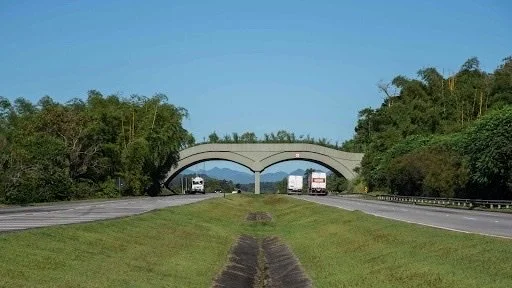
Photo caption - The wildlife bridge over interstate highway BR101 in the state of Rio de Janeiro, Brazil, pictured in 2024.
Photo credit - James Dietz
In the six years since Brazil’s first wildlife bridge was built over Interstate Highway BR101 in the state of Rio de Janeiro, a variety of animal species have been seen on the bridge, including possums, pumas, domestic dogs, marmosets, and armadillos.
Now, animal conservation scientists estimate that golden lion tamarins will pass over the bridge within the next year, marking a milestone in the effort to join two separated GLT forested habitats to protect the species’ survival. This historic moment will also stand as a model for innovation and problem-solving when it comes to protecting animals, say those who led the efforts to build and maintain the wildlife bridge.
“It's my professional dream coming true when golden lion tamarins are moving back and forth over this highway. We will have succeeded in saving the species from extinction in the wild,” said James Dietz, vice president and founding director of U.S.-based Save the Golden Lion Tamarin (SGLT).
SGLT is working alongside its partner in Brazil, Associação Mico-Leão-Dourado (AMLD), to ensure the wildlife bridge is welcoming for GLTs and other animals.
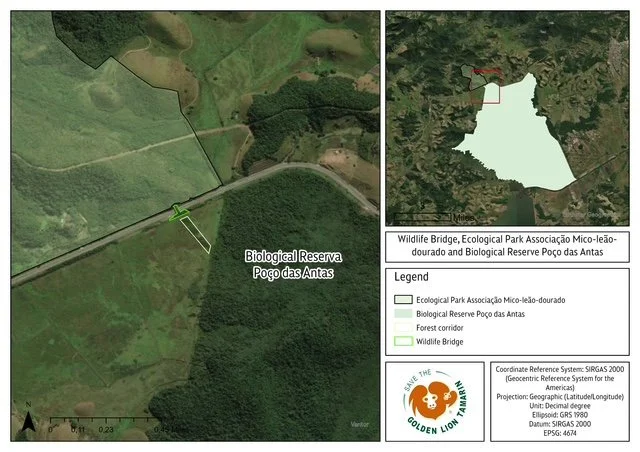
The forested overpass, which connects the Poço das Antas Federal Biological Reserve to the south of the highway and the GLT Ecological Park and adjacent forest to the north, crosses over a four-lane highway. BR101 is a transcoastal highway that stretches for 3,000 miles.. Construction for the wildlife bridge began in 2018 and was completed in 2020.
The wildlife bridge, which is only for animals and vegetation and not for human use, measures 20 meters wide and features indigenous tree species and shrubs. Carlos Alvarenga, forest engineer for AMLD, said much thought went into selecting which trees to plant because they couldn’t grow too tall or be prone to breaking so there would be no risks for BR101 drivers.
Alvarenga said the height of the trees is three meters and that the tree canopy is currently dense and mature enough to support GLTs scampering from tree to tree.
In other words, it’s now up to the GLTs to want to cross.
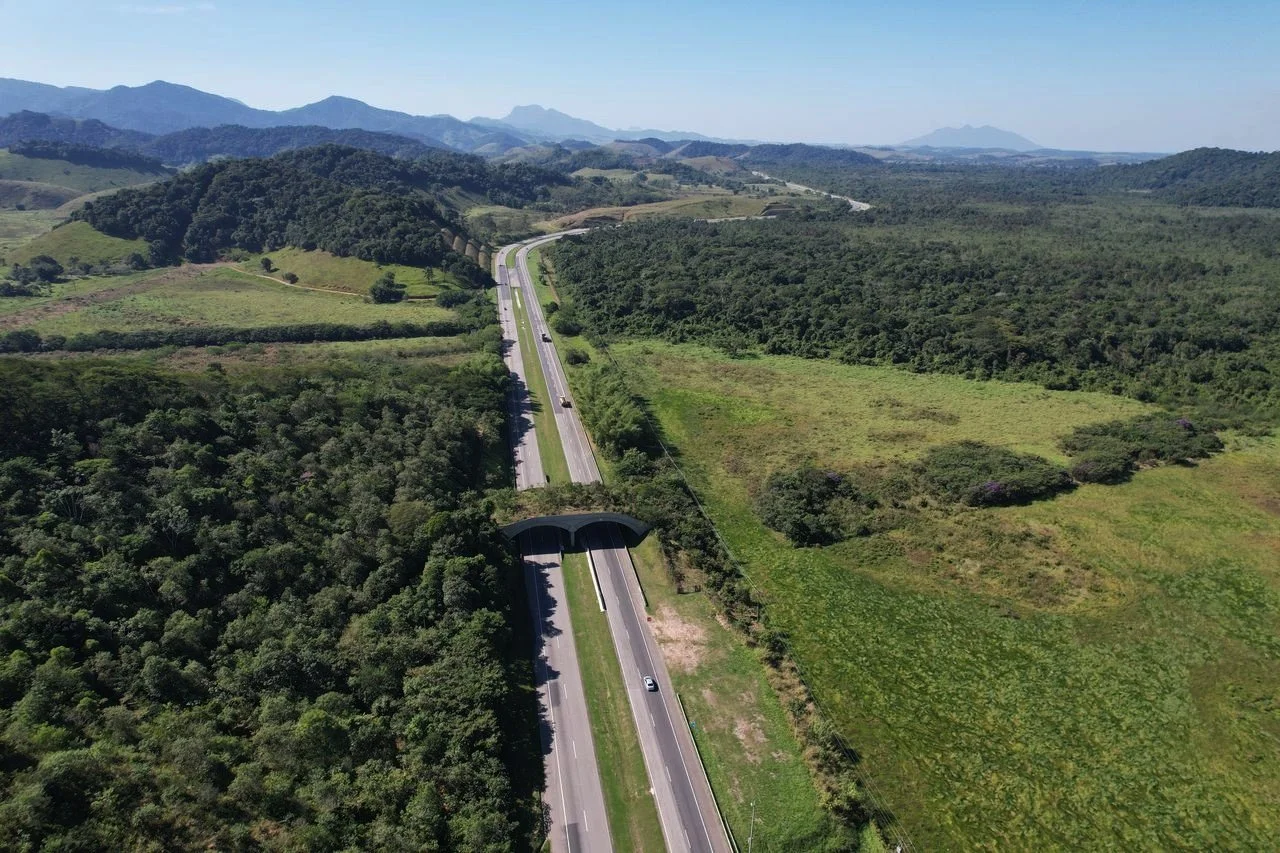
A drone photo from June 11, 2024, facing east shows the wildlife bridge over Interstate Highway BR101 in the state of Rio de Janeiro, Brazil.
Photo credit - Duda Menegassi
Motivation to cross
Dietz said golden lion tamarins have been seen in the north and south forested corridors on the edges of the bridge, but not at the same time. Hearing vocalizations from a GLT on the other side of the bridge will be a motivating factor in having the small monkeys cross to the other side, he said.
Carlos Ruiz Miranda, an associate professor of conservation at Northern Rio de Janeiro State University, has helped with the planning of the wildlife bridge and the monitoring of animal activity there.
“They just won’t cross it as an adventure,” Ruiz Miranda said of the GLTs’ desire to use the bridge.
Dietz said young adult GLTs will most likely want to cross to seek mates. “That kind of evolutionary pressure will have those young adults looking hard for other groups on the other side of the bridge,” he said.
The movement of animals on the bridge is being monitored through cameras in the trees and on the ground. Researchers are also using telemetry signals sent by the animals’ collars and observations to document the activity on the bridge.
Additionally, Ruiz Miranda, who is president of AMLD, said past research on GLT movement is helping to inform today’s conservation practices. For instance, when the National Zoo in Washington, D.C., had free-roaming GLTs from 1986 to 2007, to prepare the animals for reintroduction in Brazil, thick ropes were attached to some of the trees to help GLTs move around the zoo’s tree canopy. Likewise, ropes could be added to the trees on and around the wildlife bridge in Brazil to make it easier for GLT’s movement, said Ruiz Miranda.
A milestone in GLT conservation
In the early 1970s, there were only about 200 golden lion tamarins living in the wild in Brazil, due to habitat loss and illegal hunting. The species was upgraded from critically endangered to endangered in 2003 by the International Union for Conservation of Nature and Natural Resources’ Red List of Threatened Species following intensive conservation efforts.
The wildlife bridge helps to merge the isolated GLT populations north and south of the highway, forming a much larger and connected forested area for the animals. Experts running GLT population viability computer models say that at least 2,000 GLTs in a connected habitat are needed to reach demographic and genetic goals set by AMLD. Populations smaller than 2,000 are at an increased risk of extinction and loss of genetic diversity.
The bridge’s connection of Poço das Antas Federal Biological Reserve and the GLT Ecological Park will result in a connected, forested habitat that will support about 2,400 GLTs.
Ruiz Miranda said the wildlife bridge is critical to these conservation efforts. While the golden lion tamarin is a flagship species, the forested overpass will “benefit all terrestrial and arboreal animals in that region,” he said.
Dietz said since this wildlife bridge is the first in Brazil to cross a federal highway, it serves as a model for other conservation efforts where animal habitats are bisected by roads or other barriers. He described the effort as a compelling example of how nonprofits, the Brazilian government, and the scientific community can collaborate effectively, with the generosity of many donors fueling the work.
“This is an exciting event in AMLD and SGLT’s history and future and I’m cautiously optimistic that GLTs will love this bridge,” Dietz said.